
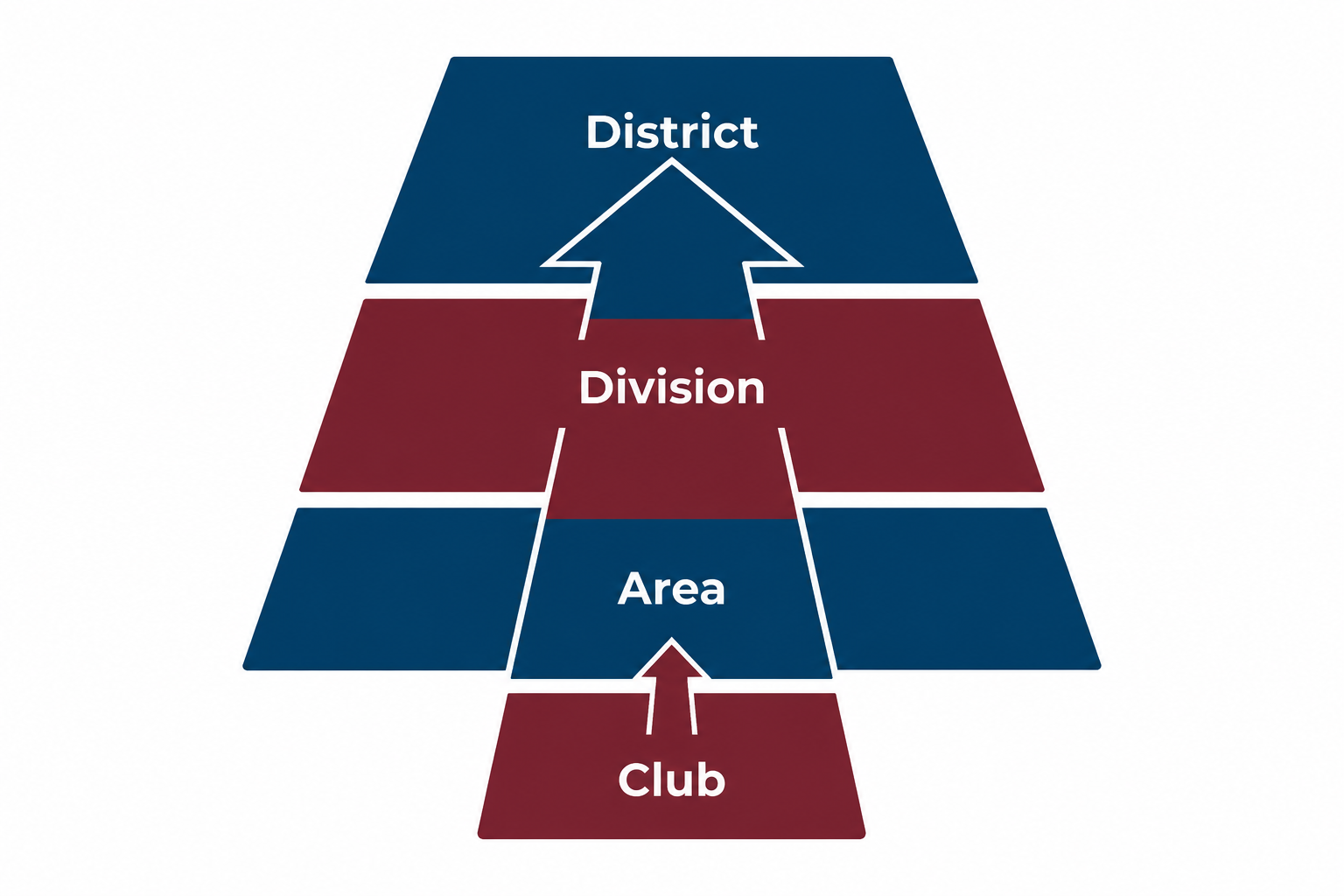
How a Membership Decision Moves Up the Ladder: From Club to District
A small, reasonable change in one member’s dues can become a District-level pattern. By the time it shows up on the dashboard, the decision behind it may be months old.
A member belongs to three clubs. Over time, the cost of maintaining all three memberships adds up, and the member makes a practical decision: keep the primary club, and let the other two lapse. The member has not left Toastmasters. Attendance, participation, and enthusiasm for the craft remain unchanged. From where the member sits, this is simply consolidation.
From the organization’s side, something different has happened. Two paid club memberships have quietly disappeared from two different rosters. The member is still active and still counted as a Toastmaster, but two clubs each show one fewer paid member on their books.
Multiply that decision by dozens or hundreds of members across a District, and a reasonable question follows: what happens when many people make the same reasonable choice around the same time, for the same underlying reason?
One Person, Several Different Metrics
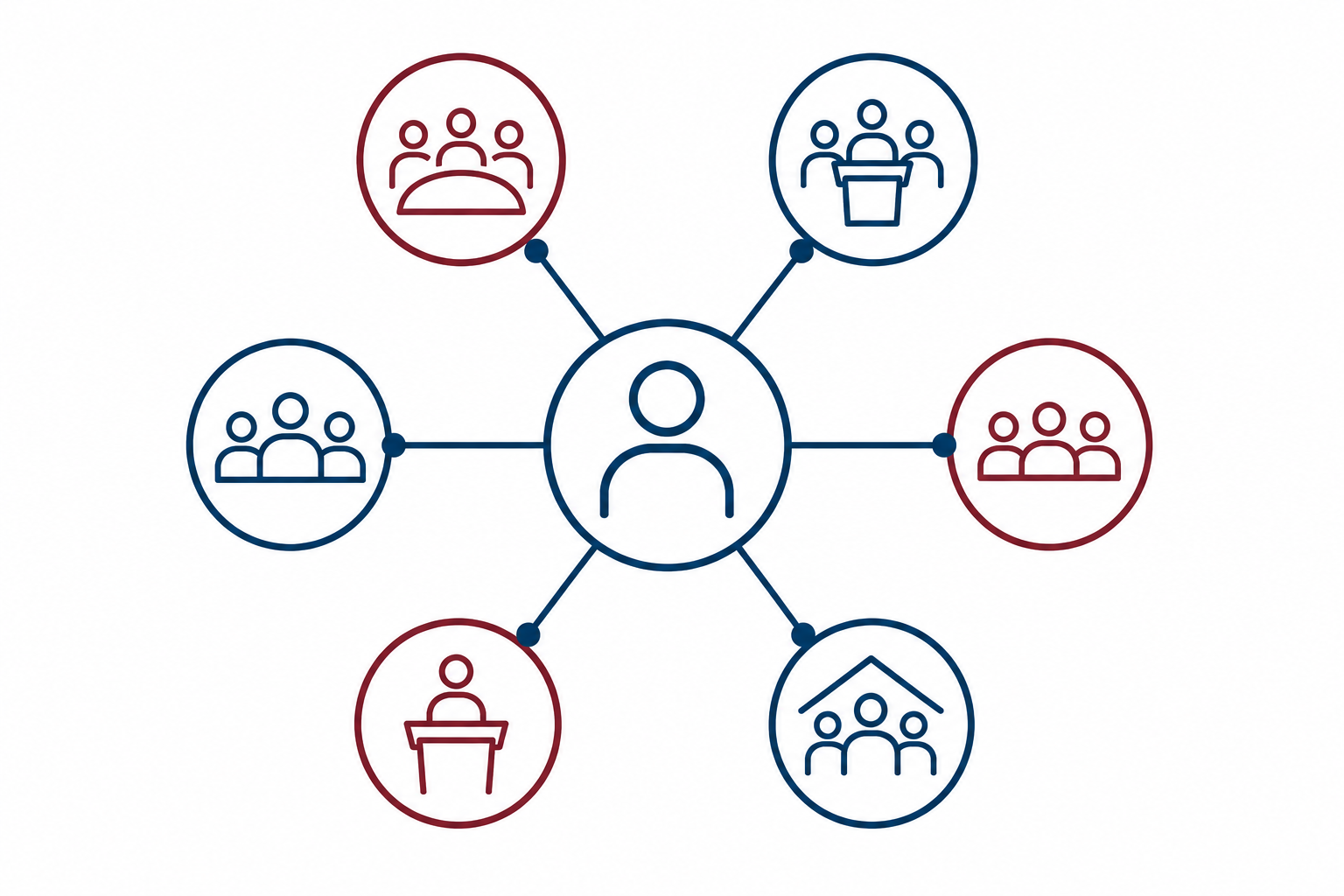
Part of what makes this pattern hard to see is that a single multi-club member shows up in several places at once. The same person can represent one individual, several paid memberships, several club rosters, one or more officer roles, and revenue recorded against more than one club. These are related figures, but they are not the same figure, and treating them as interchangeable is where organizational blind spots begin.
A member can remain fully engaged in Toastmasters as a whole while the paid-membership count at one or two individual clubs quietly declines. Retention, in the traditional sense of “did this person stay in the organization,” can look fine even as club-level capacity erodes.
Club Level: Where the Signal Begins
At the club level, the effect of a lapsed secondary membership is direct and specific. The club loses a paid membership, which can mean a thinner officer bench, more dependence on a smaller core group, and a harder path to the membership thresholds tied to Distinguished Club Program (DCP) recognition. Under the current DCP structure, a club generally needs 20 paid members, or net growth of three new, dual, or reinstating members, to qualify for Distinguished status, with higher thresholds for Select Distinguished, President’s Distinguished, and the new Smedley level.
A club does not need to lose members outright to feel this. It only needs to lose two or three people who were counted as members but were never especially visible as attendees. These losses can often fit the profile of a dual or triple member who quietly consolidates elsewhere, though not every such case follows this pattern. A club sitting comfortably above its membership threshold can find itself unexpectedly close to it the following term.
Consider a club with 24 paid members, comfortably clear of the 20-member Distinguished threshold. If three of those members are also dual members elsewhere and each lets this secondary membership lapse for cost reasons, the club’s paid count could fall to 21: still technically above threshold, but with far less room for any additional attrition, and with fewer people available to staff officer roles, mentor guests, or run meetings. The club’s public face may look unchanged. Its operating margin has not.
Area Level: Aggregation Begins
An Area Director typically oversees a small group of clubs. Distinguished Area recognition depends on the collective performance of that group: how many clubs in the base reach Distinguished status, whether the Area avoids net club loss, and whether Area Visit Reports are submitted on schedule. An Area does not need every club to struggle for its own recognition to slip. It can take just one or two clubs falling short for the aggregate to miss its target.
An Area Director can visit every club, submit every report on time, and coach every club officer team diligently, and still watch Distinguished Area recognition slip away for reasons that trace back to household budgeting decisions made two organizational levels below. That is not a failure of Area leadership. It is a measurement problem: the Area’s dashboard reflects outcomes it did not create and, in many cases, could not have seen coming from where it sits.
Division Level: A Pattern Becomes a Trend
The same dynamic repeats one layer up. A Division Director oversees several Areas, and Division-level recognition depends on how those Areas perform together. If two or three Areas each fall short for a related reason: dues-driven consolidation working quietly across several clubs at once. The Division can miss its own recognition even though no individual Area collapsed outright.
Division-level effects are often the hardest to diagnose, precisely because they are diffuse. Contests, training days, and conferences that depend on a healthy volume of clubs and members to be worth running can start to feel thinner. Volunteer pools for judging, timing, and event support can shrink. None of this points to one obvious cause. It looks, instead, like general softness, which is exactly what a slow-moving, distributed pattern looks like from the middle of an organization.
District Level: The Final Rollup
At the District level, everything arrives at once. District recognition aggregates club performance, membership payments, and club growth across every Area and Division beneath it. A District can be running excellent programs, hosting strong conferences, and recruiting actively, and still see its underlying numbers soften for reasons that have nothing to do with anything the District itself did.
This is also where revenue and membership health can start to tell different stories. If per-member dues rise while the number of paid memberships falls, total revenue may hold up reasonably well even as the number of active memberships, officer roles filled, and clubs in healthy standing all decline. A District that is watching revenue alone, rather than watching paid memberships and unique members as separate figures, can miss this divergence entirely.
The Lagging-Indicator Problem
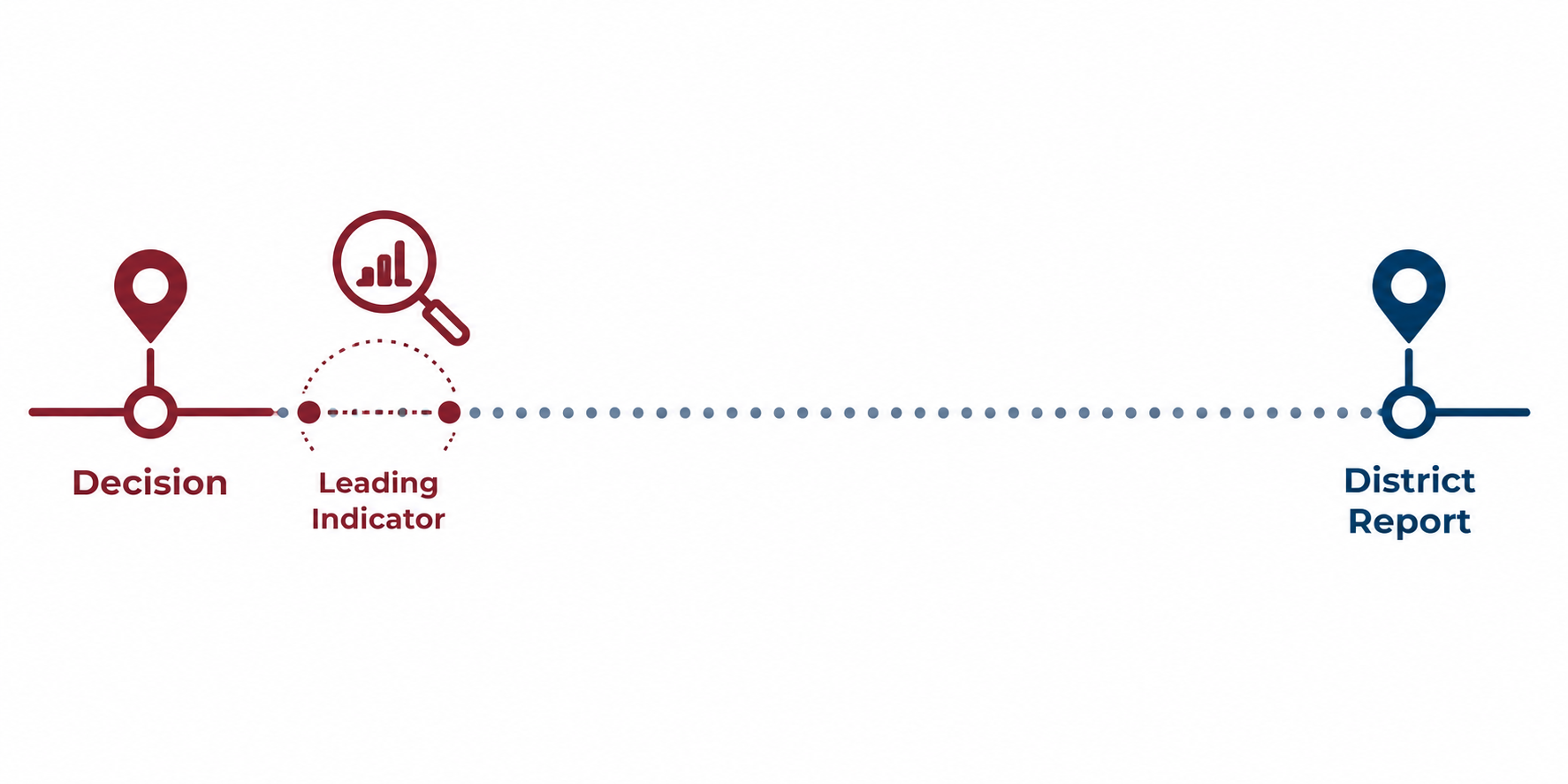
This is the structural core of the issue. Distinguished recognition and year-end membership totals are lagging indicators: they describe what has already happened, often months after the behavior that produced them. A District Director reviewing a final rollup is, in a real sense, looking at old news.
Leading indicators, by contrast, tend to show up much earlier and much closer to the individual member. Illustrative examples include:
- Members quietly dropping a secondary or tertiary club membership
- An uptick in questions to club officers about dues affordability
- Experienced dual members disappearing from a club’s active roster
- More frequent officer vacancies, especially in less visible roles
- Recurring gaps in meeting-role sign-ups
- Lower attendance at officer or leadership training
- Members renewing for a single term rather than committing further out
- Clubs sitting close to minimum membership requirements for multiple terms in a row
- Growing dependence on a small, fixed group of highly active members
None of these signals, on its own, proves a systemic problem. Taken together, and tracked over time, they can indicate a pattern worth watching well before it reaches a District report.
Why Traditional Retention Reporting May Miss It
Conventional retention reporting tends to ask a single question: did this person remain a Toastmaster? That is a reasonable question, but it is not the same question as: how many paid memberships did this person retain, and where? A member who leaves Toastmasters entirely, a member who consolidates from three clubs to one, and a member who simply lets a dormant secondary membership lapse are three different situations that call for three different organizational responses. Yet conventional reporting can treat all three as variations on the same “retention” outcome.
Separating “left the organization” from “reduced the number of memberships while remaining active” is a distinction most standard retention reports are not built to make. It is also the distinction that matters most for understanding where club-level capacity is actually going.
An Illustrative Multi-Year Pattern
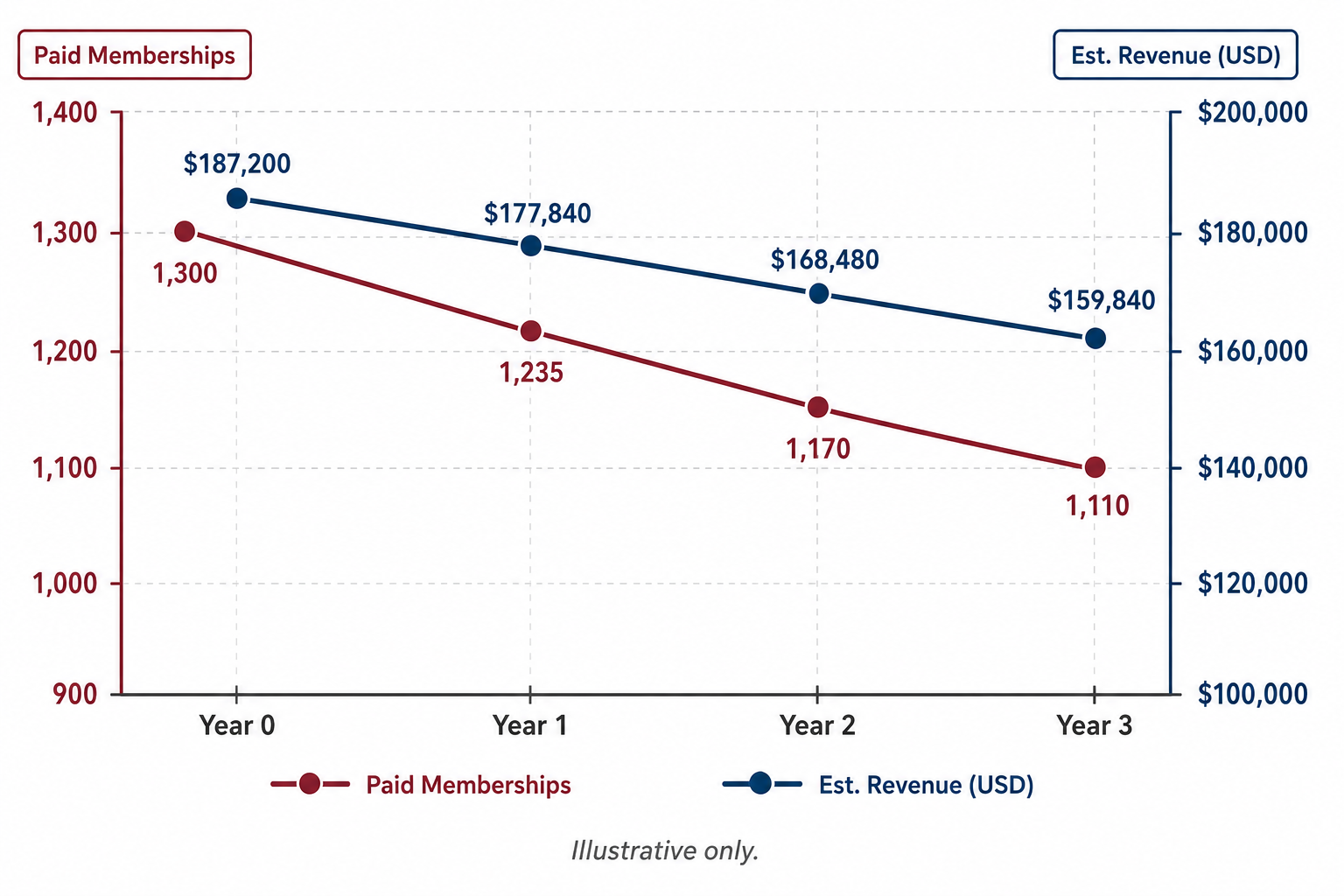
The table below is a hypothetical illustration, not a forecast or actual data from any District. It is intended only to show how a modest, steady rate of secondary-membership attrition can compound across several years even while total revenue looks relatively stable.
| Year | Paid Memberships (illustrative) | Club-Level Effect | Area / Division / District Risk |
|---|---|---|---|
| Year 0 | ~1,300 | Clubs generally stable; officer rosters full | Recognition targets appear comfortably reachable |
| Year 1 | ~1,235 | A handful of clubs lose secondary members; roles harder to fill | One or two clubs quietly miss Distinguished thresholds |
| Year 2 | ~1,170 | More clubs approach minimum membership counts | Area and Division recognition begins to soften |
| Year 3 | ~1,110 | Officer vacancies and role gaps become more common | District-level totals show a visible decline |
In this illustration, if per-member dues had risen over the same period, total dues revenue could have declined more slowly than the paid-membership count itself. This could mask the extent of the underlying membership loss if revenue were the only figure being watched.
“A District Director looking only at the final rollup is, in effect, looking at old news.”
What Leaders Should Measure Earlier
A more useful early-warning approach separates related but distinct figures and assigns each one to the leadership level best positioned to act on it:
- Unique members vs. total paid memberships: District and Division level
- Number and percentage of multi-club members: District level
- Secondary-membership renewal rate: District and Area level
- Club-level net membership change, term over term: Club and Area level
- Clubs near minimum membership thresholds: Area level
- Officer vacancy rates: Club and Area level
- Training and leadership-event participation: Division level
- Meeting-role completion rates: Club level
- Member-reported affordability concerns: Club level, escalated to Area
- Six- and twelve-month renewal intent: Club and District level
- Clubs dependent on a small number of multi-club members: Area level
- Transfer and consolidation patterns: District level
What Each Leadership Level Can Do
Club Officers
- Start renewal conversations earlier, rather than waiting for the deadline
- Ask directly whether cost is affecting a member’s other memberships
- Sharpen what makes the specific club worth the dues on its own terms
- Invest in onboarding, mentoring, and meeting quality
- Reduce dependence on a small handful of members
- Build a real officer succession plan rather than relying on the same few volunteers
Area Directors
- Track which clubs are near membership and leadership thresholds
- Compare patterns across clubs rather than treating each in isolation
- Share recruitment and training resources across the Area
- Escalate recurring affordability or consolidation signals to the Division
- Help clubs build stabilization plans before a crisis point
Division Directors
- Look for patterns across Areas, not just within them
- Coordinate membership-building efforts Division-wide
- Monitor volunteer and event-staffing capacity as a leading indicator
- Avoid treating each struggling club as an unrelated, isolated case
- Feed trend-level analysis up to District leaders
District Leaders
- Separate revenue analysis from membership-health analysis
- Track unique members and paid memberships as two distinct figures
- Build reporting that can isolate secondary-membership attrition specifically
- Ask members directly about affordability and perceived value
- Use rolling, mid-year indicators instead of waiting for year-end totals
- Direct support toward clubs showing early signs of fragility, before they need rescue
The Value Question
Dues are not the only variable behind consolidation. Members may also step back from a secondary club because of scheduling conflicts, a program that feels repetitive, slower progress than expected, weak onboarding, or simply because the club does not offer anything distinct from the member’s primary club. Leadership cannot control every household budgeting decision. It can influence whether each membership feels distinct and worth renewing on its own merits.
The question worth asking at every level is the same one: what unique value does this particular club provide that the member cannot already get from the member’s other club?
Conclusion
Picture one member sitting down with two or three renewal notices, deciding which memberships are worth keeping. That private moment is the earliest point in a chain that can eventually touch a club’s officer bench, an Area’s recognition, a Division’s event calendar, and a District’s year-end report.
None of this argues for pressuring members into memberships they cannot afford, and none of it implies that any single member’s choice is disloyal or unreasonable. The goal is narrower and more useful: recognize the signal early, understand what it does and does not mean, strengthen the value each club offers, and stop discovering the pattern only after it has already reached the year-end dashboard.
“By the time the decline reaches the District dashboard, the real decision may already be months old. Effective leadership begins by looking for the signal before it becomes the score.”
Questions District Leaders Should Be Asking
- Do our reports distinguish unique members from total paid memberships, or do we treat them as the same number?
- How many of our members hold more than one club membership, and is that number growing or shrinking?
- Are we tracking secondary-membership renewal rates separately from primary-membership renewal rates?
- Which clubs in our District are within a small margin of their minimum membership threshold, and for how long have they been there?
- If per-member dues rise, would our revenue reporting mask a decline in actual paid memberships?
- Do we have a mid-year indicator set, or do we effectively wait for year-end totals to learn what already happened?
- What does our District currently do to make each club’s membership feel distinct in value, rather than redundant with a member’s other club?
Related Resources
- Distinguished Club Program
- Club Success Plan
- Club Officer Training
- Membership-Building Resources
- Area and Division Leadership Resources
- Find a Club
Source Note: This article references publicly available Toastmasters International program materials, including the Distinguished Club Program guide, the District Recognition Program (covering Distinguished Area, Division, and District requirements), and Toastmasters International’s published membership dues schedule. Readers verifying specific thresholds, percentages, or dues figures for their own District should confirm current terms directly at toastmasters.org, as program requirements are periodically revised by the Board of Directors.
All numeric examples in the “Illustrative Multi-Year Pattern” table are hypothetical and do not represent actual membership data for any club, Area, Division, or District.